Tuesday, August 08, 2006

2-4 August - HONDURAS (and NICA wrap-up)

Tegucigalpa

Hi all, Phil here.
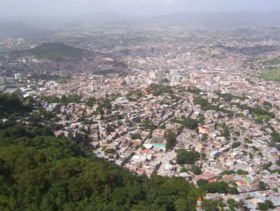
Seems the photos are working.... and of course, I´m unprepared... so I nicked this photo from Wikipedia of Tegucigalpa... we´ll get some originals soon.
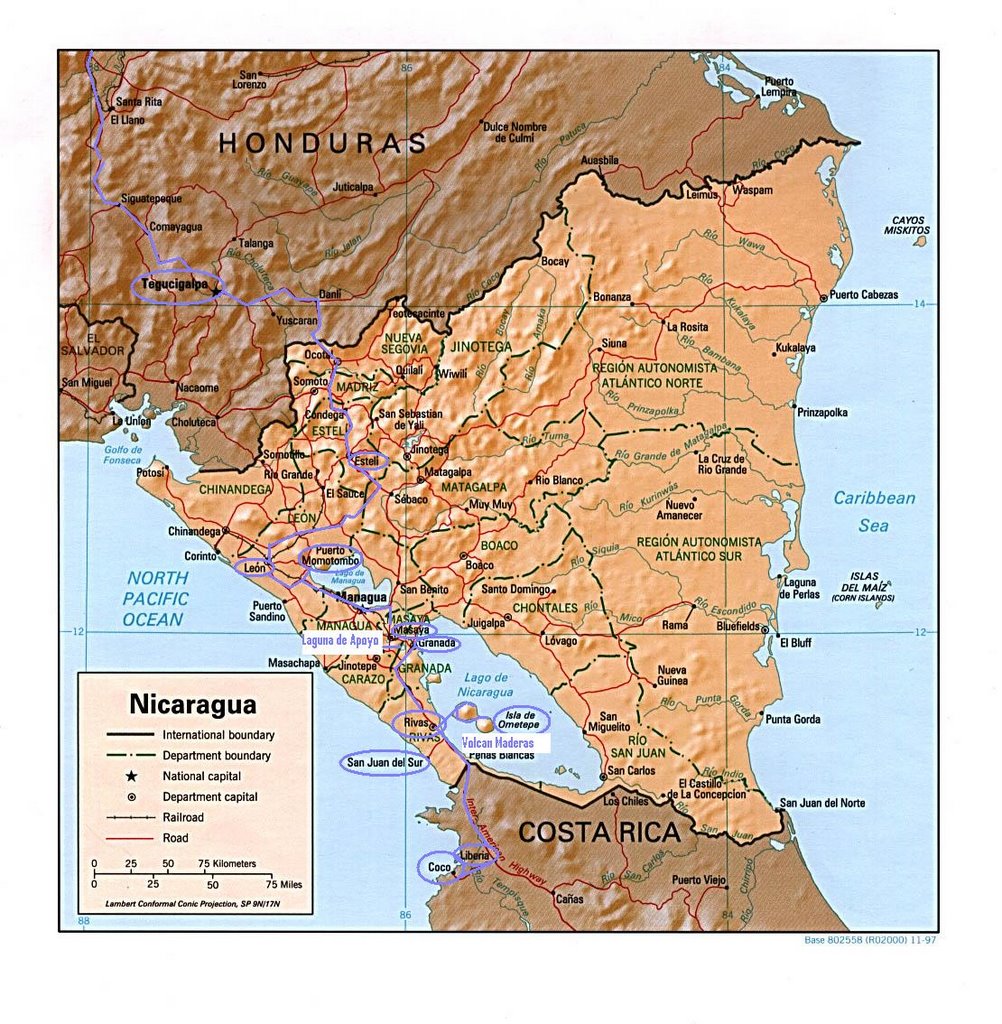
We took a Tica Bus (coach) from Estelí in Nicaragua, had a pretty uneventful Border crossing, and made our way to Tegucigalpa.
It´s a gorgeous city, really steep, everyone must have massive calves walking up and down the streets, and comes complete with obligatory noisy buses, tooting horns, and elderly women approaching us, calling us ¨her children¨ and asking for a ´regalo´(gift).

We spent a couple of days here and found ourselves stuck! There has been an ongoing teachers strike (huelga) during which 8,000 of them blocked off the only major highway north. We had to keep up-to-date reading the El Heraldo newspaper, which was one of the continuing sources for the Fidel Castro revelations.... talk about the end of an era. It took about 3 days after the abdication of power to his brother for the papers to announce he has cancer also. One of the interesting side notes is that his brother (forget his name now, anyone know?) has been in charge of the military in Cuba since 1959.

(P.S. Just checked the El Heraldo website, the teachers are still front page - always good articles to read in Spanish)

Oh yeah, Karen and I went walking through La Tigra National Park too.... a good walk, great views of the city, and got offered a lift (about an hours drive) in the back of a pickup by a Syrian, Mohammed, and his Honduran family... so, Thanks Mohammed!

NICARAGUA WRAP-UP
Highlights:
1. The view of Volcán Momotombo and Lake Managua from Leon Viejo
2. Travelling with Rachel and Kuhtahya
3. Granada and Leon - definitely worth a visit

Funnies:
1. Running out of money on Isla de Omotepe
2. Karen´s Spanish teacher - Blás, a very astute guy
3. Phil´s Dive Guide - Lorenzo, VERY loud.

National Beer: Victoria or Toña

Tuesday, August 01, 2006

30-31 July - Leon and its Surrounds

Leon

Leon is another colonial town, the sister town of Granada. It seems to have more life of its own, and is definitely grittier than Granada. It has it´s fair share of churches and the largest cathedral in Central America, but is also known as the home of student resistance, the Sandinista movement and has a number of galleries, murals and photo walls documenting it´s political history. We recommend picking up a book and reading about the Iran-Contra affair, and the Sandinista movement, our curiosity is piqued!

Last night was a festival for the Saint of the local cathedral, so they had effigies of christ on the cross walked through town, with a band, church bells ringing, and LOTS of pyrotechnics - most of which were let off from home-made mortars in public areas, close to everyone! There was also a pyrotechnic bull (a guy in a make-shift costume) with pyros randomly flying off as wicks burnt, scaring children and harming others!

Leon Viejo

At the foot of Volcan Momotombo lies the ruins of Old Leon, it was rediscovered in 1967. With a variety of ruins showing brick structures of churches, merchant houses and more, the highlight was the view from what was the fort overlooking the town. This vista is AMAZING. You see Lake Managua, surrounding and highlighting a chain of volcanoes, perfectly conical, some islands within the lake ... just wait for photos. It was spectacular.

Oddly enough, Old Leon is a fair distance away from it´s present location, it was apparently moved due to a volcanic eruption of Momotombo in 1610.

San Jacinto Boiling Mud Pools

About half an hour out of Leon is a bizarre creek floodplain with bubbling mud pools and steam vents dotting the landscape. Local kids wander around with thongs, poking and prodding the mud, hoping to make a buck out of molding little candlestick holders from freshly warm mud. The water sits in the pools at about 100°C, and the steam, smoke and sulphur are palpable. Our guide told us that locals have had pools of boiling mud rise up under their beds overnight, and that running underground services within the area is, shall we say, problematic!

29 July - Volcan Masaya

Today we walked up to Diria, a town overlooking Laguna de Apoyo, along with our teachers, as the last activity with our school... Diria originates in the preColombian era and it´s name (like that of Ometepe and others) comes from the native language (not Spanish). It has a nice big church, older than white settlement in Australia.

we then proceeded on a BIG transport day... many phases (they aren´t modes for all those people concerned with the apostrophe ¨´s¨ debacle - which remains unresolved) of transport

1. From Laguna by LandRover to base of the crater.
2. Foot to Diria
3. Bus to Masaya
4. Taxi to Laguna then to Masaya
5. Bus to Volcan Masaya
6. Bus with Puerta Rican Missionaries to the top of Volcan Masaya
7. Foot around the bat caves and Santiago Crater
8. Someone´s jeep when we hitched down the Volcano
9. Mini-Bus to Managua
10. Mini-Bus to Leon (balancing packs on laps)
11. Taxi to Hostal (to find it was full)
12. By Foot in drenching rain to a second hostal.
13. Sleep

Volcan Masaya

A really impressive active volcano with the active smoking Santiago crater. We were first impressed by the lava-strewn landscape solidifed into a bizarre rocky world...
There are two active volcanoes with 5 craters between them. We were impressed by the signs asking people to park their cars facing downhill, ¨for a quick getaway¨ in case of eruption, or requesting that people ¨hide under their cars¨if the crater starts spitting out rocks... this is one ACTIVE volcano.

We then went with a guide down a lava tunnel (or Bat Cave). Interesting formations, loads of stalagmites and -tites and hardhats with headlamps which barely lit the way.

24-29 Laguna de Apoyo Spanish School

Apologies for the delay of a week or so... and the lack of photos...
We´ve been off the beaten path for a week, and blogger has been stubborn with posting photos... just means more reason for a slide night when we get home!

This week we were at the Proyecto Ecologico Escuela de Espanol. We had a week staying at a guest house, where we both had one-on-one tutoring for 4.5 hrs per day. Karen´s professor was Blas and Phil´s was Madeline (Photos to follow). One other student in attendance was Bruno, a nice swiss guy with boofy blond hair who was studying there for 3 weeks.

SPANISH SECTION
-------------------
Karen y yo fuimos a aprender español por una semana. La escuela se llama ¨Proyecto Ecológico¨, que ofrece bucear en la Laguna de Apoyo. Karen recibió más conversacion mientras yo aprendí mas sobre de gramatica. Yo buceé dos veces, cada uno fué asombroso. Mi primera buceo de agua fresca fué muy único. La laguna tiene solo una especie de planta y un par de especies de peces que son nativos porque la laguna esta aislada.
-- Escrito por Phil

-------------------

Karen learnt much about Nicaraguan history, festivals and national symbols; along with grammar, verbs, verbs and more tenses of verbs.
Phil learnt verbs. Phil got frustrated learning verbs and not being able to say what he wanted, particularly when your teacher is trying to conduct a conversation on political history! (I would´ve been more content reading ¨Run Spot Run¨)

But that said Phil can now read and write a little better and Karen can engage locals in political debates on street corners (yeah, like Karen´s the sort to incite political uprisings!)

The Laguna was Phil´s FIRST FRESHWATER DIVE!! It´s a crater lake that has been isolated for all history, and so has only eight species of fish (one of which is introduced) and only one species of plant (Charcha). How did the other 7 species get there?

The lake is about 5km wide and 200m deep, and is a lovely clear blue, visibility extends to about 10m max, and the bottom is mainly mud and rock, with occasional volcanic outcroppings which is where the fish hide-out. The water temp is 28°C - no thermoclines.